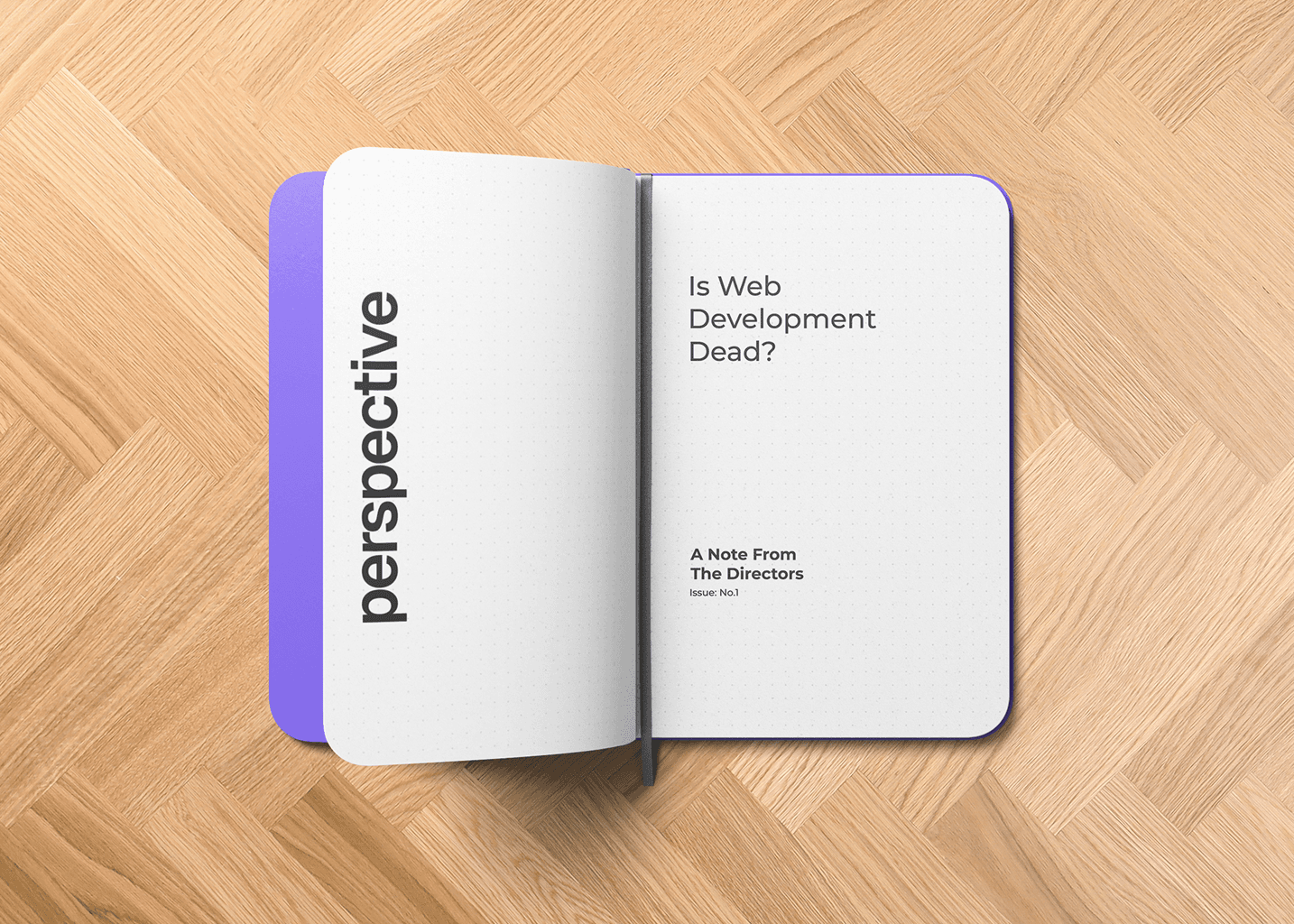
Is Website Development Dead?
Every few years someone declares something “dead” and this time it's web development!
What pulled the trigger? AI or “vibe coding” did, and hey - I get why the claim feels true. You can describe a feature in plain English and watch a working version appear in minutes. Never before has that been done.
But the problem is that a working version is not the same thing as a reliable system. And if you run a business, you don't get paid for “it runs on my machine” or "but it looks cool in production".
To avoid sounding like a scared developer I will admit one caveat that this version of coding is expanding the boundaries of what's possible for businesses and founders everywhere.
But.. it comes with a warning (Of course..) and that's because a good 95% of the projects we come across that are AI or vibe coded have extremely serious flaws. Some have issues with the user experience, others overlook simple foundational security failsafes.
So no, web development isn’t dead. The bit that’s dying is the idea that the job is mostly typing.
What do you think “web development” is?
If your definition of web development is “turn requirements into code”, then yes, that part is getting cheaper and faster.
If your definition is “build a site that can be trusted, improved, measured, and maintained without falling apart”, then it’s not dying. It’s becoming more important because the cost of shipping fragile software just dropped.
That’s the twist nobody talks about. AI lowers the barrier to creating software, and it also lowers the barrier to creating software you cannot safely touch six weeks later.
What vibe coding actually is (and why it feels like the end)
“Vibe coding” is basically building by prompting. You steer, the model generates, you keep going until it looks right, and you only slow down when something breaks.
And it feels like magic because it's unlocked a whole new world for people who don't know coding language, but that in it's own right is dangerous.
The developers who win are the ones who get specific, not the ones who vibe the hardest. How can you get specific if you don't know the fundamentals or pitfalls that you learn with years of experience? Specificity and intent still matter, maybe more than ever.
That’s why the “coding is dead” crowd and the “AI is just a tool” crowd keep talking past each other. They’re describing different phases of the same build.

The part that’s "dying" is typing. The part that matters is judgement
AI is very good at producing code quickly. That’s not controversial anymore.
What’s still scarce is judgement: what to build, what not to build, what will break later, what must be measured, what must be owned, what needs guardrails, and what do those guardrails look like.
Even those predicting job title changes aren’t saying “software disappears”. They’re saying the work shifts, and it won’t look like it used to.
From a business perspective, the takeaway is simple: if someone is selling you “we can build it fast with AI”, your first question should be “cool, who owns the consequences?”
Why most vibe-coded projects look fine until they hit reality
This is the part I’m comfortable being quite straight up about.
In the real world, a huge chunk of vibe-coded projects fall apart the same way: they optimise for getting to “working”, not for staying reliable. That’s why so many of them come with massive issues once they meet real traffic, real users, and real world scenarios.
In the last year we've had 7 new clients come to us needing help on projects they had commissioned (which ended up being vibe coded projects) that had failed. The common failure patterns we saw and have seen elsewhere in the market are:
- The code works, but nobody can explain it. Which means nobody can maintain it safely.
- Every fix is local. Patch one thing, break another because nothing was designed as a system.
- No tests, no safety net. So every change is a gamble.
- Hidden requirements surface late. Tracking, SEO structure, permissions, integrations, performance, accessibility, content governance.
- Ownership is murky. Accounts, hosting, repos, analytics, handover docs. It's all very unclear and usually when problems arise your AI-dev disappears.
None of that is “AI is bad”. It’s what happens when speed, not quality, becomes the only definition of progress.
So where is vibe coding genuinely brilliant?
Let's not just sh*t on the whole entire thing - There is a version of this that is absolutely worth embracing.
Vibe coding shines when the downside of being wrong is low. Prototyping ideas for validation, experiment's to test flow or UI, internal tools that aren't core infrastructure, or quick automation scripts are all great uses.
It's brilliant when you're looking for learning and testing, not for reliability. But used carelessly it's just a faster way to create a future rebuild or tarnish your brand

Is it really a cheaper alternative?
The moment you ship something that the business depends on, you’re in a different game.
A production website is not just pages. It’s lead capture, tracking, analytics, integrations, performance, security, content updates, and the ability to change without fear. It's also brand representation - This is a big one people forget.
This is where “traditional coding is dead” becomes a dangerous misunderstanding. If your site is a growth asset, the hard part is not generating the first version. The hard part is everything that happens after launch.
The cost always shows up later when you start asking your platform to do real work it might not actually be built to do. What costs you ask? Further development, possible a full rebuild, wasted time, reputation loss, and - since this happens alot - new providers that just leave you high and dry.
Want our 8 qualifying safety questions on working with A.I providers?
If someone says they can or will build your site with AI, it's better to be safe than sorry. It's the Wild West out there currently and every man and his dog offering AI coding - So I thought it'd be best to help arm you some qualifying questions in case you're ever looking for a provider.
- Who owns the domain, hosting, CMS admin, analytics, & any code repositories?
- What's the plan for updates after launch, and who's responsible?
- Is there a staging environment, or are changes made directly on the live site?
- What breaks first when we add a new service, landing page, or integration?
- How are leads tracked end-to-end (not just "the form emails us")?
- What happens if we switch providers? Can another team take over cleanly?
- What are the performance and reliability checks pre-launch?
- What does the handover pack include?
If they can answer those clearly, you’re probably dealing with real engineering. If they can’t, you’re being sold speed without accountability and it's on you when it breaks.
What are your options, realistically?
If you strip away the hype, you’ve basically got four sensible paths. None of them are “anti AI”. They’re just honest about what you’re buying.
Option 1: Use vibe coding for prototypes only
If you’re trying to validate an idea, a flow, or a rough MVP, vibe coding is brilliant. Treat it like a sketch, not the house. Build fast, learn fast, throw it away if you need to. The goal is insight, not longevity.
Good when: you’re early, testing demand, or the project has low downside.
Option 2: Use AI, but build like an adult
This is the version most people mean when they say “we use AI”. AI helps with speed, but you still run a real build process: proper scope, clean structure, tracking, staging, QA, and a maintenance plan. The AI output gets reviewed and held to standards like anything else.
Good when: the website is going to be a real part of sales, marketing, or operations.
Option 3: Start with a template, then harden it
Sometimes the right move is not custom straight away. If you need to launch quickly, a template can work, as long as you keep it clean and set it up properly. Then you harden it over time so it stays stable and easy to improve.
Good when: you want speed now, but you know the business will evolve.
Option 4: If you already have an AI-built site, don’t rebuild yet. Audit it.
A lot of businesses already have something half-built, or a site that works but feels risky to touch. Before you scrap it, the smart move is an audit: what’s structurally sound, what’s fragile, what’s missing (tracking, ownership, handover), and what the lowest-risk fix path is.
Good when: you want clarity before spending money twice.
Or, if you want the fastest, lowest drama next step - Start with our Website Development page. It'll show you how we approach this when the goal is reliability, not just speed.
And if you want to talk it through, you can reach us on our Contact page.
Frequently asked questions: